Loading...
Serving Redding, CA and surrounding areas. (530) 319-6848
An uninsulated basement is an open door for Redding's triple-digit summer heat. Properly insulated basement walls and floors keep that heat out and give your air conditioner a fighting chance - even on the worst days of the year.
Basement insulation in Redding, CA slows the movement of heat through your basement walls and floor, which helps the rest of your home hold a steady, comfortable temperature - most jobs take one to two days and the space is usable the same day or the next. In a city where summer temperatures regularly top 100°F, an uninsulated basement acts like a heat sink that works against your air conditioner around the clock.
Many homes in established Redding neighborhoods like Buckeye and Enterprise were built before California's modern energy standards required meaningful insulation levels. If your home dates from before 1990, there is a reasonable chance your basement has little or no insulation at all, or whatever was installed has degraded significantly over the decades.
Basement insulation pairs naturally with work below the main floor. If your home sits on a crawl space rather than a full basement, our crawl space insulation service covers that application in detail. For the densest, most air-tight basement wall treatment available, our closed-cell foam insulation page explains how spray foam compares to other materials.
If rooms directly above the basement stay stuffy even with the system running constantly, heat moving up from an uninsulated basement may be part of the problem. This is especially common in older Redding homes where the basement ceiling has no insulation at all. It is not always the only cause, but it is one of the first things worth checking in Redding's climate.
If your electricity bills feel out of proportion to what neighbors pay for similar-sized homes, poor basement insulation could be a contributing factor. Heat entering through uninsulated walls and floors works against your cooling system all day long. Redding's long, intense cooling season means even a modest improvement in insulation translates to meaningful savings over a full summer.
Step into your basement on a hot July afternoon and pay attention to how it feels compared to the main floor. An insulated basement should feel cooler and more stable in temperature. An uninsulated one will feel warm and stuffy because the concrete walls are absorbing and radiating outdoor heat. A noticeable temperature difference is a clear signal the walls are doing nothing to slow what is coming in.
A persistent musty odor or dark staining near the base of your basement walls can signal moisture intrusion, which matters because wet insulation loses most of its effectiveness and can support mold growth. Redding's dry climate reduces this risk in summer but winter rains and older foundations can still allow seasonal water infiltration. Address moisture before insulating, not after.
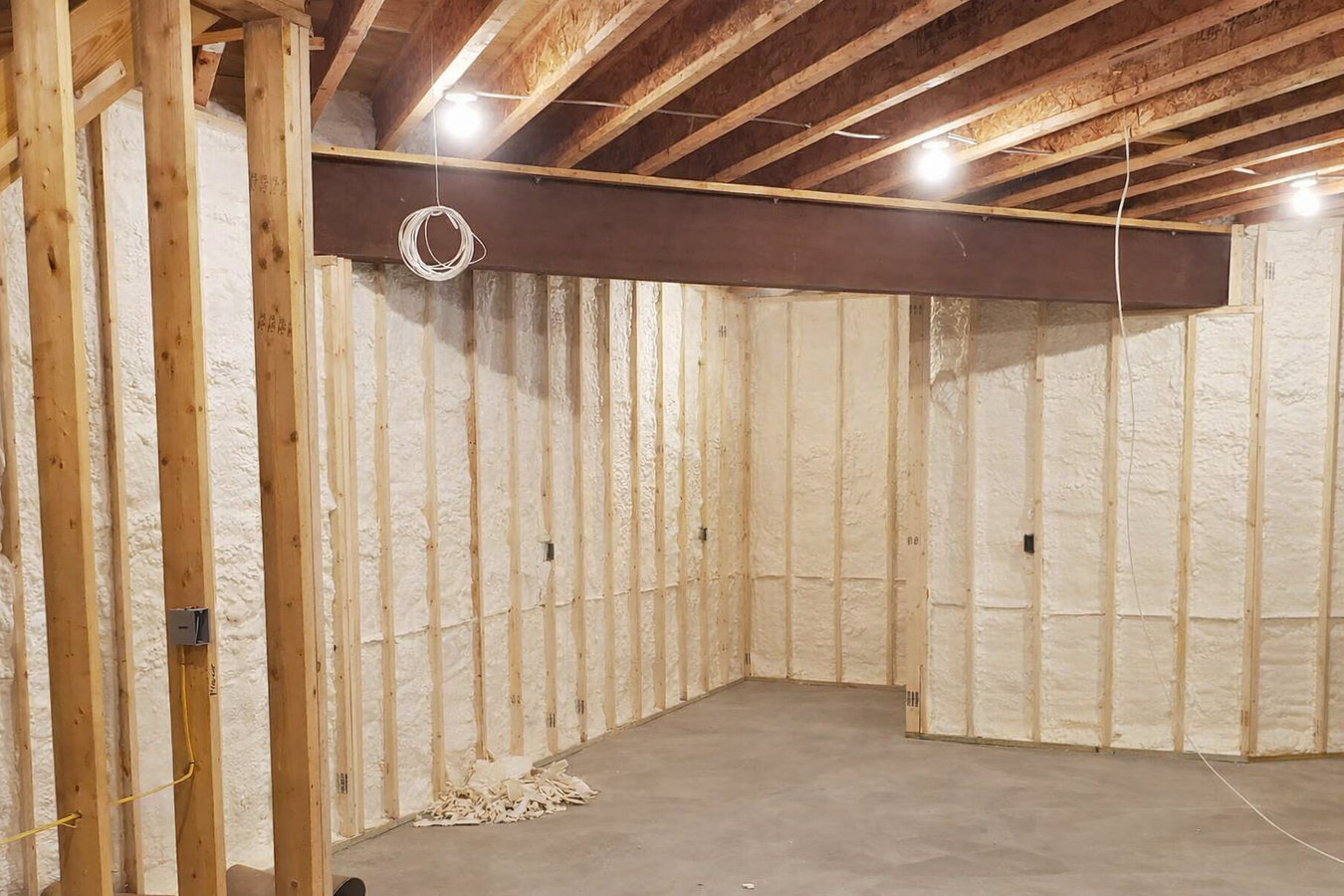
We install spray foam, rigid foam board, and fiberglass batts in basements across Redding and the surrounding region. The right material depends on how your basement is used, how much moisture it sees, and how much clearance you have to work with. Spray foam is our most requested basement wall treatment because it seals air gaps while it insulates, which matters in older homes where concrete walls have many small penetrations. It also acts as a moisture retarder, which is useful in basements that see any seasonal dampness.
Rigid foam board is a strong alternative for homeowners who want solid performance at a lower material cost. Fiberglass batts are most commonly used in basement ceilings, fitted between floor joists to protect the rooms above. All three options are available through Redding Insulation, and we will recommend the one that fits your home and your budget honestly.
For the highest air-sealing performance in a basement wall application, our closed-cell foam insulation service is worth reviewing. If your home has a crawl space that also needs attention, our crawl space insulation service addresses that as a stand-alone job or alongside basement work.
Best for basement walls that need both insulation and air sealing, particularly in older homes with many penetrations through concrete.
Suited to homeowners who want solid insulating performance at a lower material cost than spray foam, with good moisture resistance.
Commonly used between floor joists in the basement ceiling to protect the living space above in unfinished basements.
Recommended for any basement with a history of dampness, staining, or musty odor before any insulation material goes in.
Redding's climate zone is one of the most demanding in California for cooling loads. The California Energy Commission classifies the Redding area as a high-heat zone where summer temperatures regularly reach 105°F to 115°F for weeks at a time. That means basement insulation here is not primarily about winter warmth. It is about keeping brutal summer heat from radiating inward through uninsulated concrete walls and forcing your cooling system to run nonstop from June through September.
Many Redding homes, particularly in older central neighborhoods and communities like Anderson and Shasta Lake, were built decades before California's modern energy codes took effect. Basements in these homes frequently have no insulation or only degraded remnants of what was originally installed. If your home was built before 1990 and no one has looked at the basement in years, a quick assessment is worth your time.
PG&E, which serves most Redding homeowners for electricity, offers rebates for qualifying insulation upgrades. California's building energy standards also set minimum performance requirements for any permitted basement finishing or renovation work. The California Energy Commission publishes the current requirements, and we handle permit coordination on your behalf so you do not have to navigate that process alone.
We respond within 1 business day. We will ask a few quick questions about your basement's size, whether it is finished, and what problems have prompted you to call. There is no obligation and no cost to talk.
We walk through your basement, check the current insulation state, look for any moisture issues, and measure the space. You get a written quote before we leave your driveway - no ballpark estimates over the phone.
If your project requires a City of Redding permit, we pull it on your behalf. Standard residential permits typically process within a few business days, and we build that timeline into the schedule so you are not waiting.
The crew clears any remaining items, seals gaps around pipes and wires, and installs the insulation. Most basement jobs finish in one to two days. We walk you through the finished work before we pack up so you can see exactly what was done.
Free on-site estimate. Written quote before we start. No pressure, no obligation.
(530) 319-6848We focus on insulation in one of California's hottest climates, which means every material choice and installation method is calibrated for summer temperatures that regularly exceed 105°F, not for milder coastal conditions.
Every basement project starts with an on-site assessment and a written estimate that spells out the work, the materials, and the total cost. You know exactly what to expect before anything begins.
PG&E offers rebates for qualifying insulation upgrades in Redding, and the paperwork can be confusing. We know the documentation requirements and can walk you through the process so you capture any savings you are entitled to.
We inspect for moisture issues before any insulation goes in - a step that protects you from the expensive problem of discovering mold behind new insulation. If we find something, we tell you before we start, not after.
We have worked on basements in Redding's established neighborhoods and in newer subdivisions on the south and west sides of the city. Our focus is straightforward: give you an honest assessment of what is there, recommend what actually makes sense for your home, and install it correctly the first time.
Closed-cell spray foam delivers the highest insulating value per inch of any material available, making it ideal for tight basement wall applications where space is limited.
Learn moreCrawl space insulation addresses heat and moisture infiltration from below the main floor, a common problem in older Redding homes with unvented or poorly sealed crawl spaces.
Learn moreRedding's cooling season starts early and runs long - locking in your installation date now means you will feel the difference before the worst heat arrives. Call us or request a free estimate online.